
Kitchen · Equipment
I read blender complaints for a living. Almost none of them were about the blender.
Thousands of notes from people who spent real money on a good machine and stopped using it inside two months. The same three reasons, over and over, and not one of them was the motor.
 By Robin Marsh · Everyday Blender
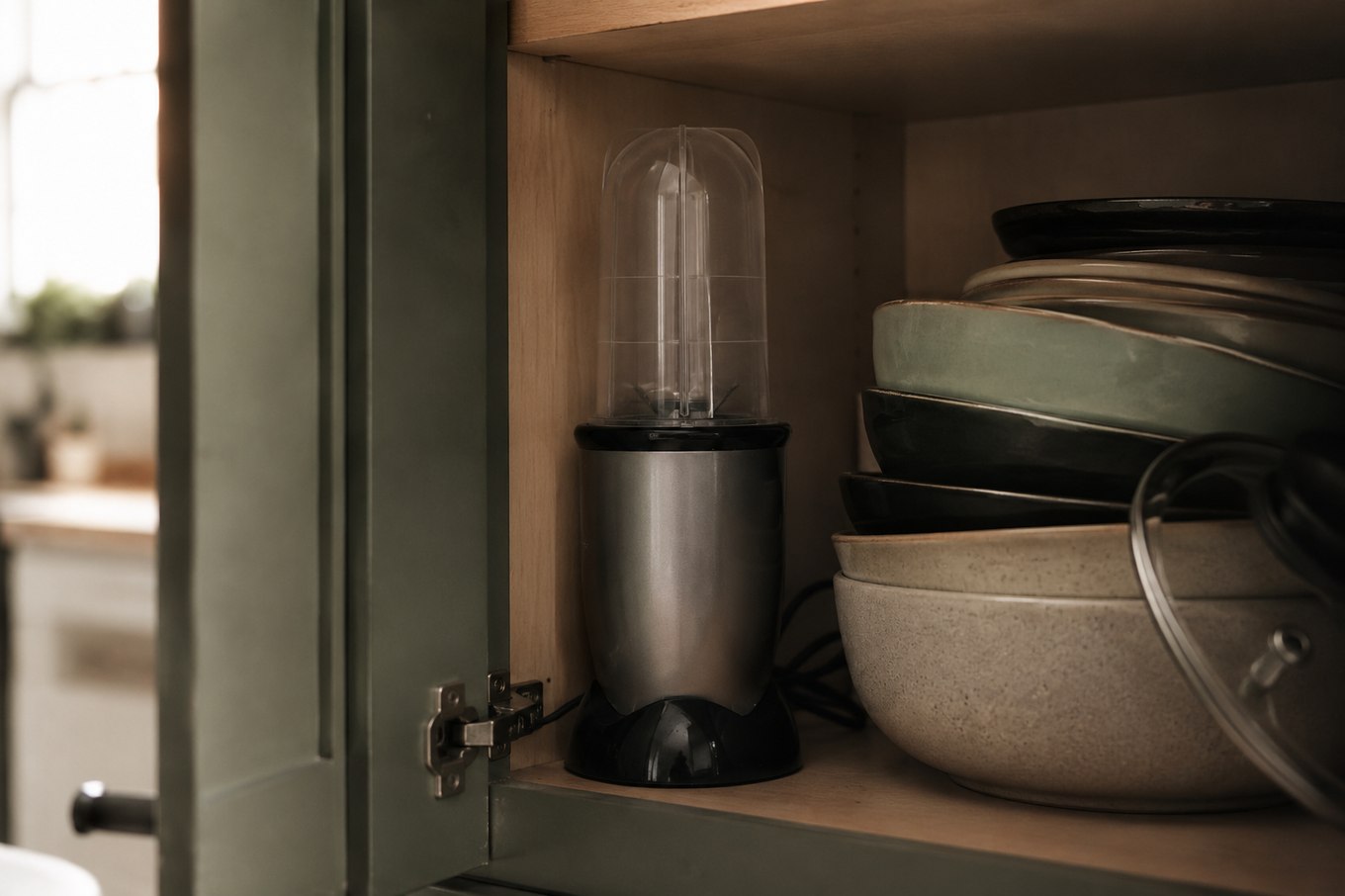
For most of my working life I sat on the receiving end of what people write in after they buy a kitchen appliance. Reviews, support tickets, survey boxes, the long rambling emails that arrive at eleven at night. Thousands of them.
You learn something strange doing that job. The complaints are almost never about the thing you would expect. Motors fail rarely. Blades stay sharp far longer than people think. The machine, in the overwhelming majority of cases, is fine.
What people are actually writing to tell you, underneath the words they use, is that they stopped. The machine still works. It is just collecting dust in a cabinet, next to the other things they meant to use every morning.
The same three sentences, over and over
Once you have read a few thousand of these you stop seeing individual people and start seeing three sentences wearing different clothes.
The first is the cleaning, and it is the single biggest reason machines end up collecting dust. Not that it is hard, but that it is a pain at exactly the wrong moment. You have somewhere to be, and there is a jar on the counter with fruit drying onto the inside of it, and you know that in four hours it will be worse. Every use ends with a chore waiting for you.
The second is hunger. People describe making something healthy at seven and being hungry again by ten, standing at the snack drawer confused and slightly annoyed with themselves. The smoothie was supposed to be filling, and it wasn't. They usually blame their willpower. It is almost never willpower.
The third is the morning itself. Not the blending, which takes ninety seconds, but the deciding. What goes in, is there enough, did the spinach turn. The habit does not die while you are using the machine. It dies while you are standing in front of the fridge at 6:50am with your coat half on.
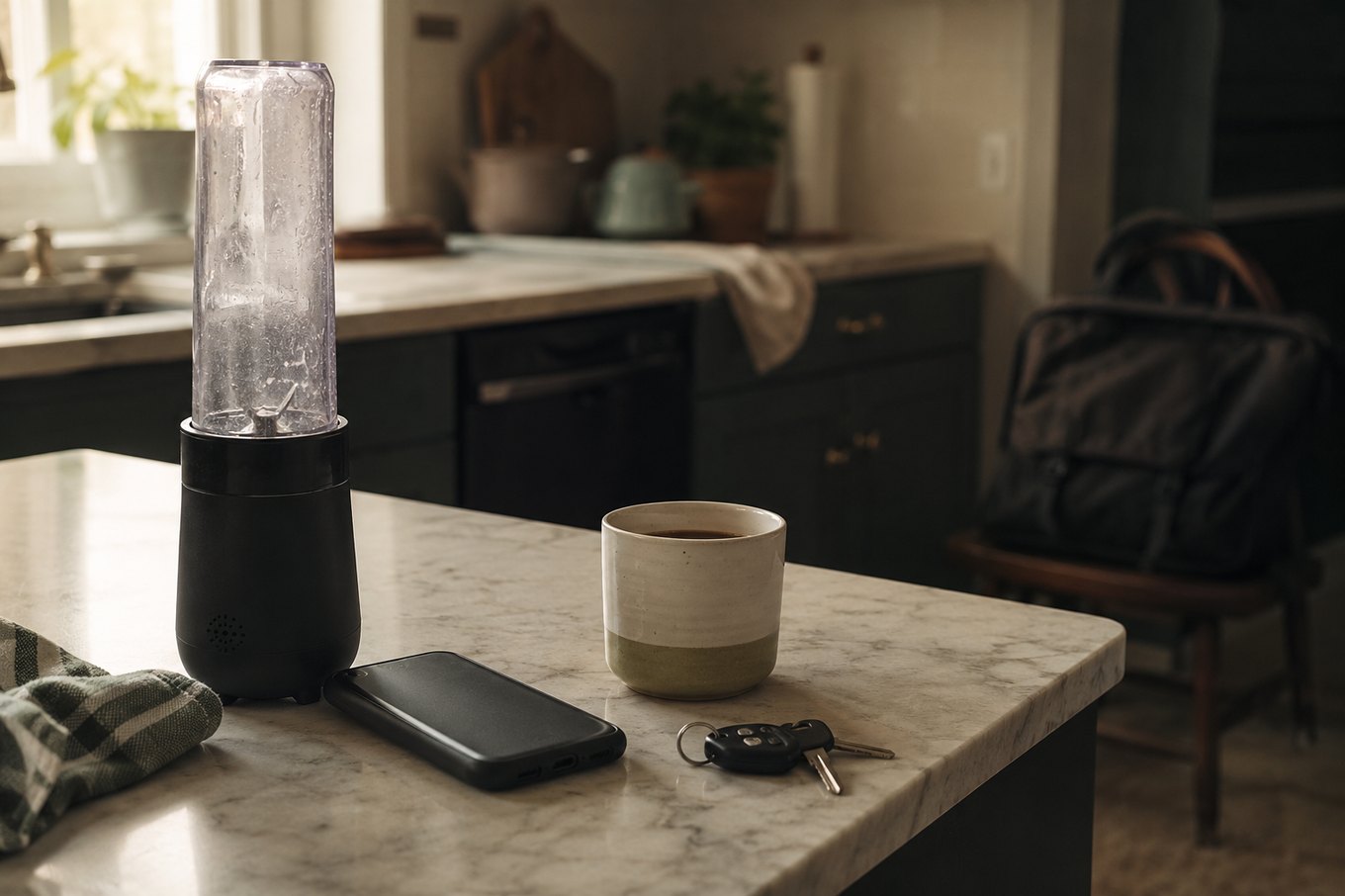
If you own one, some version of this is probably in your kitchen right now. See how many of these sound familiar:
- You used it every morning for two or three weeks, then once or twice a week, and you could not say exactly when it stopped.
- Rinsing it "later" became a jar soaking in the sink overnight, and the soaking became not getting it out at all.
- You made something healthy at seven and were hungry again by 9:30, so what was the point.
- You bought a $79 tub of something green because it felt like the serious thing to do, and you could not say what it actually did.
- And the machine has drifted to where things go when nobody wants to say out loud that they stopped: the far corner of the counter, and then the cabinet.
None of that is a character flaw. It is what happens when nobody hands you the boring second half of the manual.
Why the usual fixes don't hold
By the time people write in, they have usually tried to fix it themselves. The same five attempts turn up over and over, and each one fails the same way.
More recipes. Recipes are the thing the internet has in genuinely infinite supply, and they are free, which tells you something about how much of the problem they solve. A recipe fixes one morning. It does not fix the cleanup, because the cleanup happens after the recipe is over, and it does not fix the deciding, because a recipe is one more thing to decide about.
A better blender. I have watched people buy their way from a perfectly good machine to a more expensive perfectly good machine, and then write in about the same three things eight weeks later. If the machine were the problem, the upgrade would have fixed it.
The $79 greens powder. It feels like commitment, which is why people buy it at exactly the moment the habit starts wobbling. But a tub of powder does not clean the jar and it does not keep you full, and most of what is in it you could eat as, well, vegetables. There is an honest chapter on this in the book, and you already suspect what it says.
Willpower. "I just need to be more consistent" is the sentence people use to beat themselves up. But the people who stick with it are not more disciplined than you. They have quietly removed the three places where discipline was being spent every morning, which is a different thing entirely.
Buying the smoothie instead. The counter version works. It just costs $9 to $13 a time, which is a strange amount to pay to avoid a machine you already own.
What actually changed it
At some point I stopped reading the notes one at a time and started counting. Across thousands of them, the pattern held with almost boring consistency:
- Cleaning was the single most named reason a machine stopped being used. In the unhappy notes it came up more than any other complaint, more than noise, more than price, more than anything the motor ever did.
- The hunger complaint almost never blamed the smoothie. People blamed themselves, in writing, to a stranger. That one took me a while to get over.
- And when an independent lab test of 23 popular protein powders found heavy metals in some of them and made the news, the questions in my inbox changed overnight. Almost nobody selling powder answered them straight.
The thing that turned this from a pile of complaints into something useful was noticing that all three of the big problems have fixed, boring answers. Not motivation, not a new routine you have to white-knuckle. Fixes.
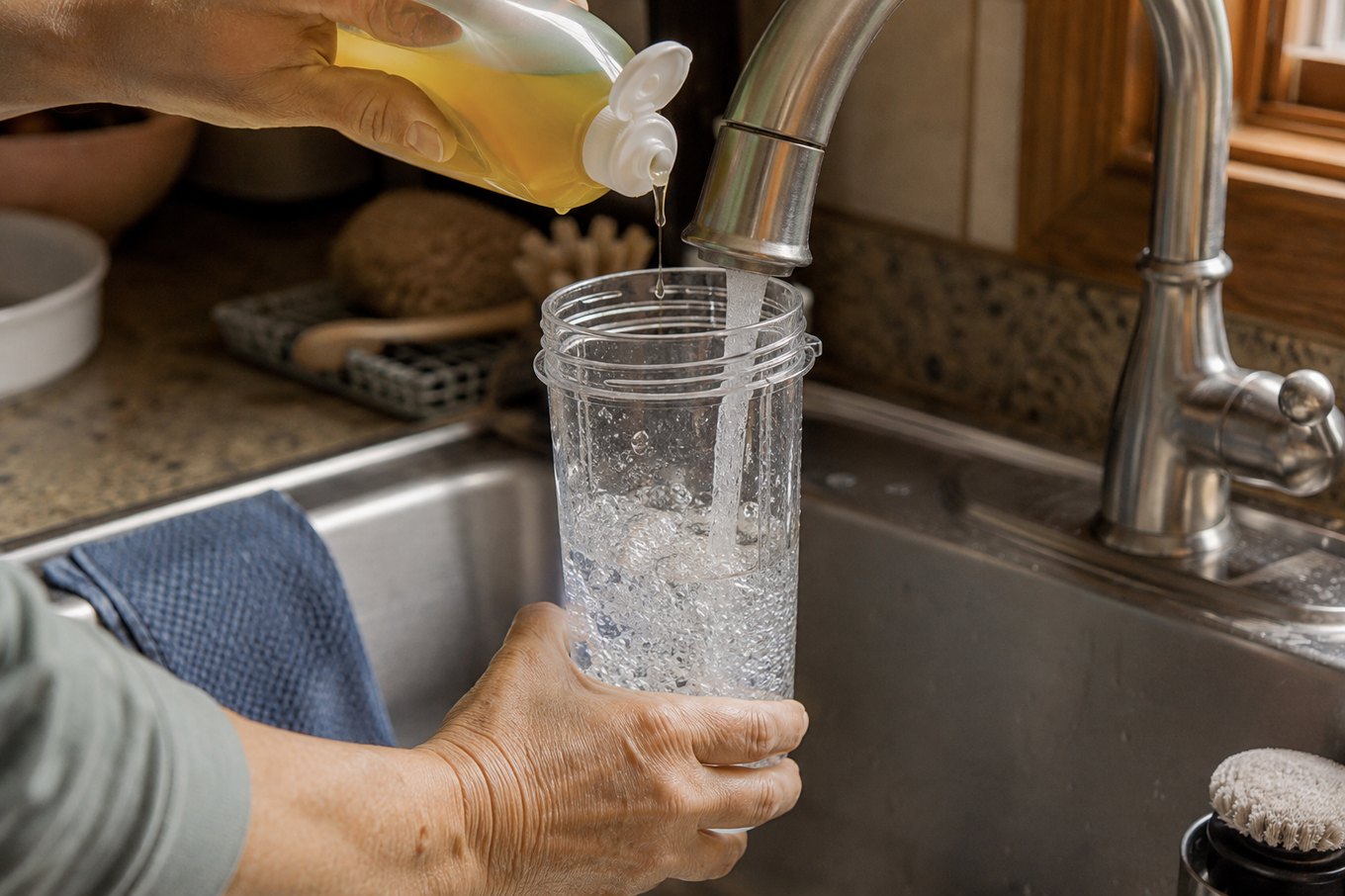
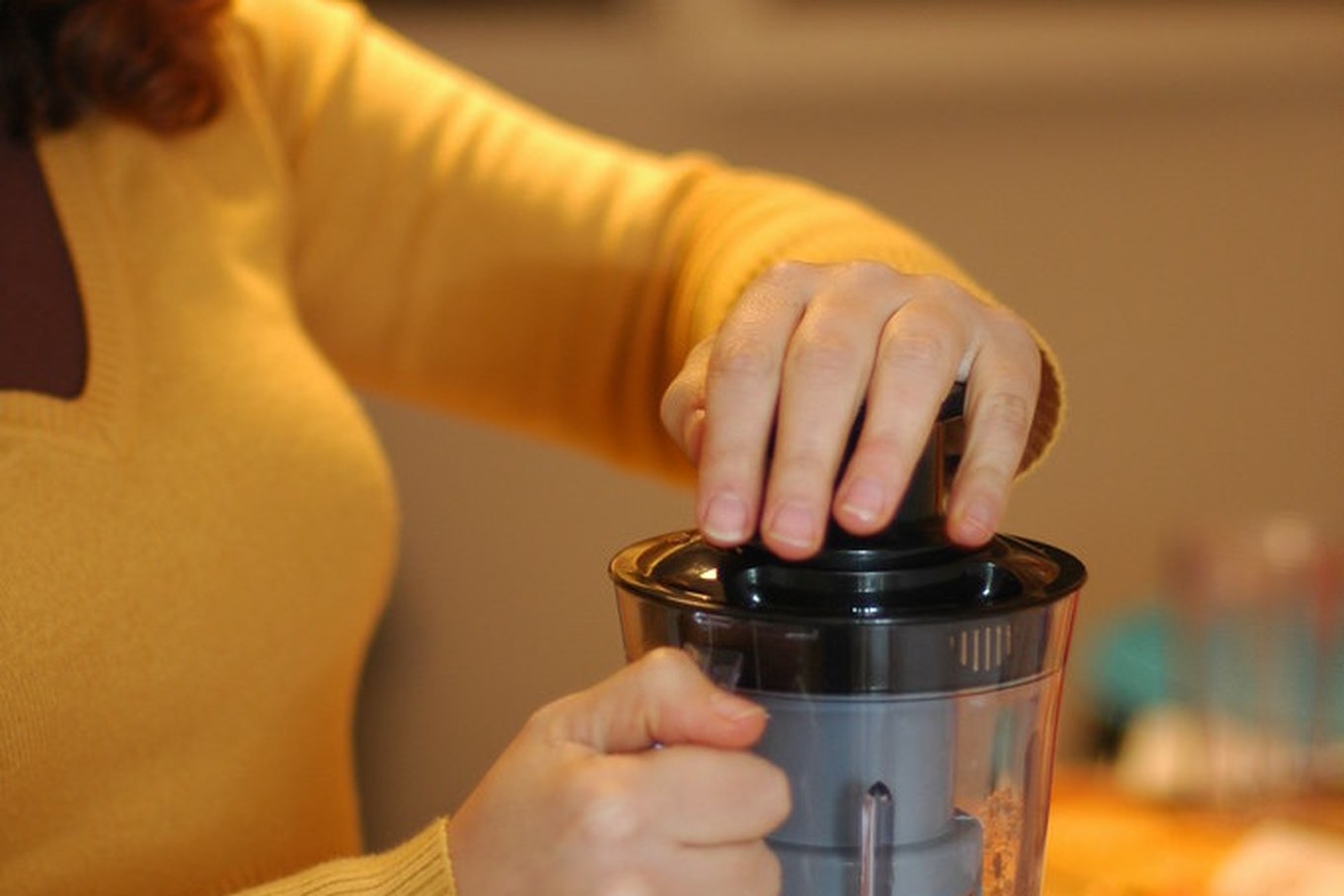
The cleaning one is almost embarrassing. Warm water, one drop of soap, thirty seconds on high, rinse. Done at the counter while you are still holding the cup, it takes about ninety seconds and there is nothing waiting for you later. It is so easy that the frustrating part is that nobody tells you, because the manual is busy talking about wattage.
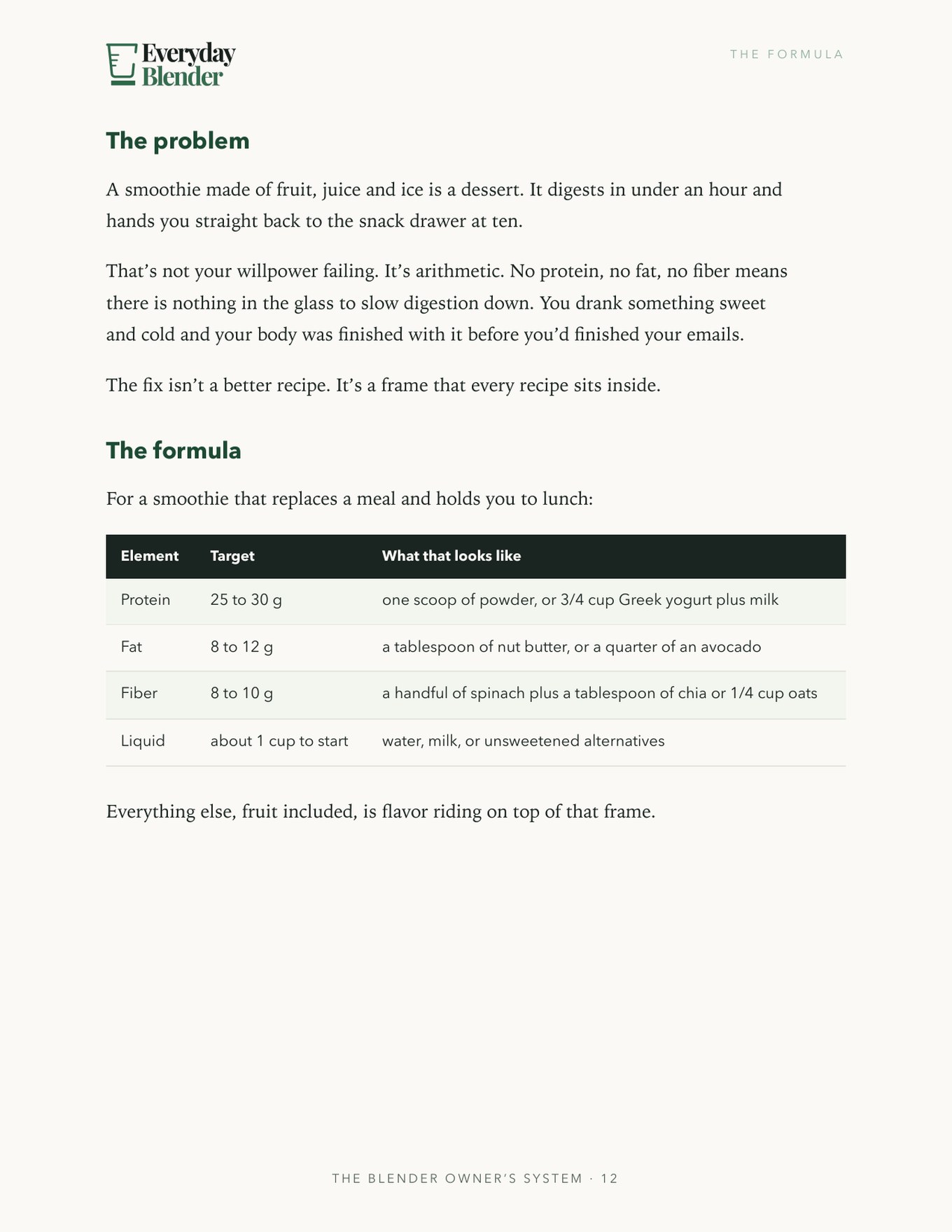
The hunger one is just math, and it is the piece that surprises people most. A smoothie keeps you full until lunch when it hits roughly 25 to 30 grams of protein, 8 to 12 grams of fat, and 8 to 10 grams of fiber. That is what separates a real meal replacement from something sweet and cold that your body is finished with before you have finished your emails. Fruit is flavor riding on top of that frame, not the frame.
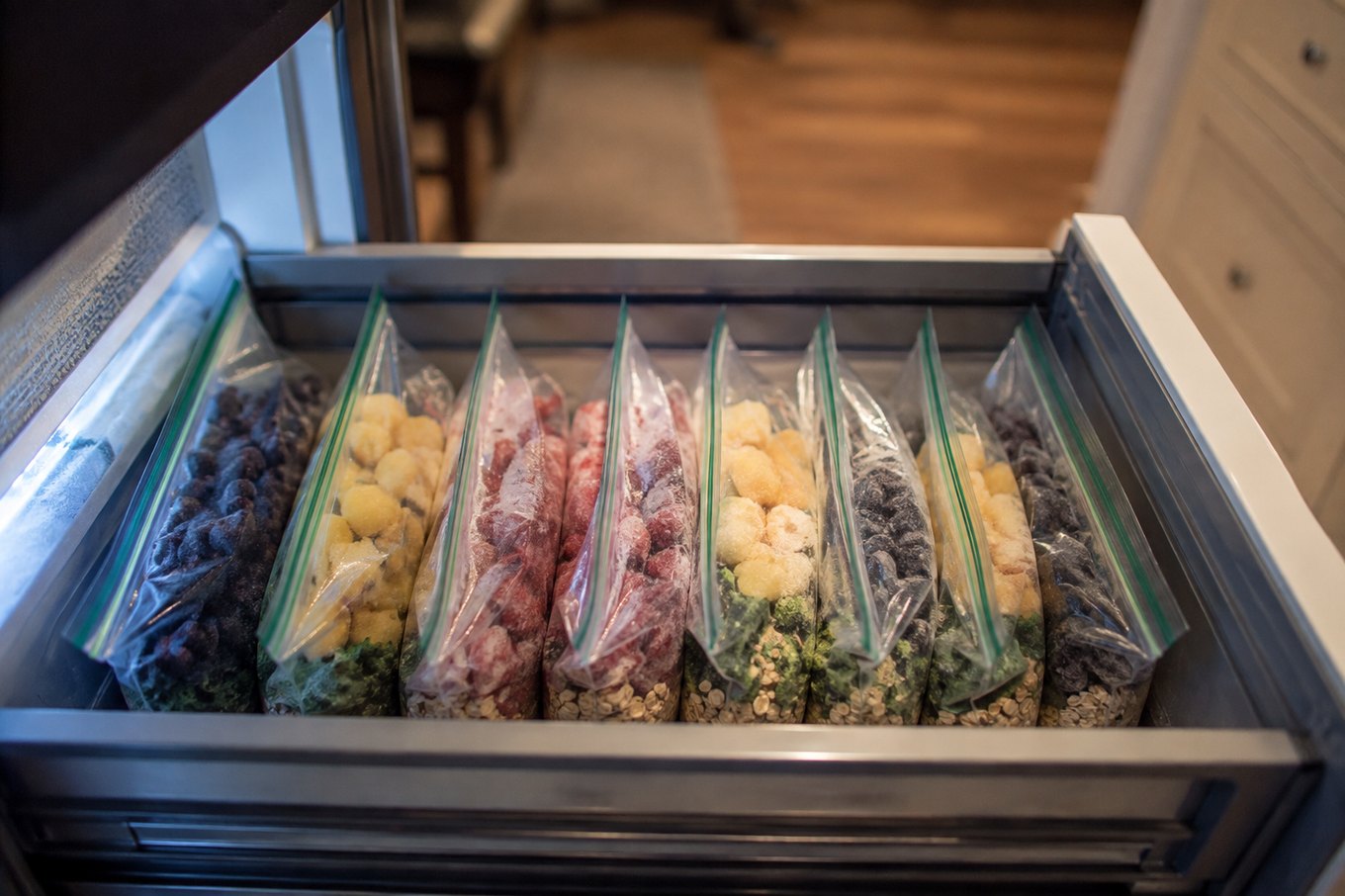
And the deciding one is solved the night you stop deciding. Twenty minutes on a Sunday, ten bags built and stacked in the freezer, and every morning after that is the same: take a bag, add liquid, blend. There is nothing left to decide at 6:50am, because you already decided on Sunday when you had the time. That is the whole difference between a routine that needs willpower and one that runs on its own.
The book this turned into
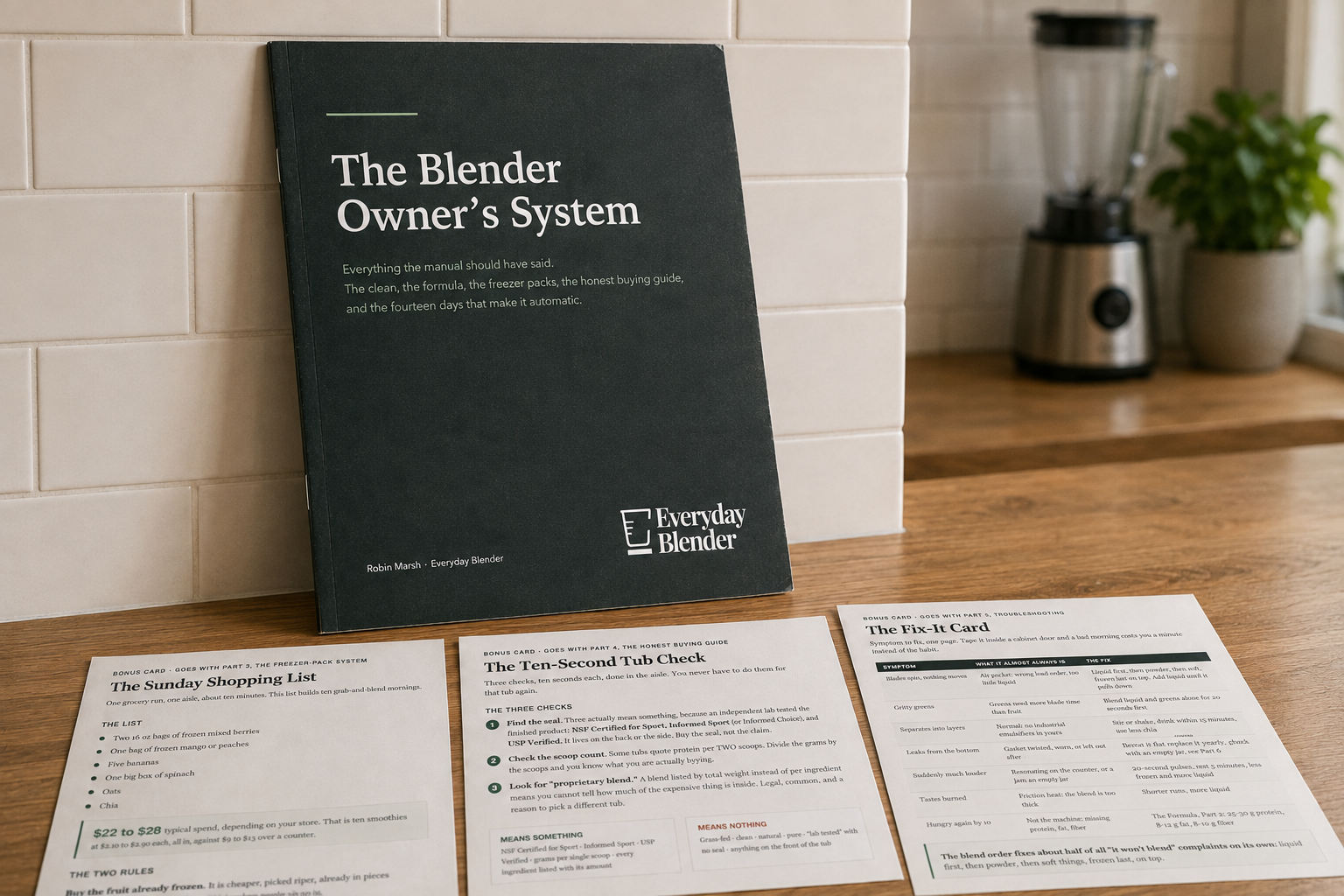
It is called The Blender Owner's System. Forty-nine pages, seven parts, and it is the thing I wish had been in the box: the clean, the formula, the freezer packs, the honest buying guide for what goes in the cup, the troubleshooting table, the repair-or-replace call, and a fourteen-day run-in that takes you from owning one to not thinking about it.
It is a PDF, it arrives in about fifteen minutes, and it costs $29.

Here is what it is built to change inside the first two weeks, in plain terms:
- The cleanup stops being a chore, because it happens in the ninety seconds while you are still standing at the counter.
- Your smoothie gets built as a real meal replacement, designed to keep you full until lunch instead of handing you back to the snack drawer.
- Mornings stop needing decisions, because Sunday already made them.
- You stop paying for powders that do not earn their price, and you can read the back of any tub in ten seconds.
- The machine stays on the counter. Which is the whole point.
$29instant download30-day guarantee
What readers have said

“Two weeks later, my blender was out of the cabinet and on the counter.”
MARIE K., OHIO“I spent good money on a nice blender. But it was such a pain to clean that I’d leave it in the sink, and by then the smoothie had dried hard around the blade. So within a few weeks, it was at the back of the cabinet.
Then I was sent The Blender Owner’s System to review. The first thing it told me to do was clean the blender the second I poured. You add warm water and one drop of soap and run it on high for thirty seconds, so it cleans itself. It takes ninety seconds, and the jar was clean before my coffee was ready.
That weekend I bagged up ten smoothies’ worth of fruit for the freezer. So every morning was just tip a bag in, add milk, and blend.
Two weeks later, my blender was out of the cabinet and on the counter. And I’d used it almost every morning.”
— Marie K., Ohio
Received a free copy of the book in exchange for an honest review.
“Ain’t much of a book-review person. I will say I had a blender sitting in a cabinet that I was fixing to get rid of because cleaning it was a pain. Tried the 90-second wash the way the book says and left the machine sitting out afterward. Been using it about four mornings a week since. So I reckon it worked.”
— Ray T., Tennessee
Received a free copy of the book in exchange for an honest review.
“I expected mostly recipes and was pleasantly surprised that it wasn’t that. The useful part for me was learning why my smoothies never kept me full. I changed breakfast to include the protein, fat and fiber amounts in the book, and after about a week I stopped having my usual mid-morning snack. That alone made the book worthwhile for me.”
— Carol B., Minnesota
Received a free copy of the book in exchange for an honest review.
“I bought this blender two years ago and I bet it spent a year and a half shoved under the counter. I tried Robin’s freezer bag thing on Sunday and made ten of them while the kids were running around the kitchen. By Wednesday I realized I’d used the blender three mornings in a row without even thinking about it. The cleaning trick is what got me though: warm water, one drop of soap, run it, rinse it. Why did nobody tell me that when I bought the thing?”
— Amy R., Oklahoma
Received a free copy of the book in exchange for an honest review.
Instant download30-day guarantee
What's in the seven parts
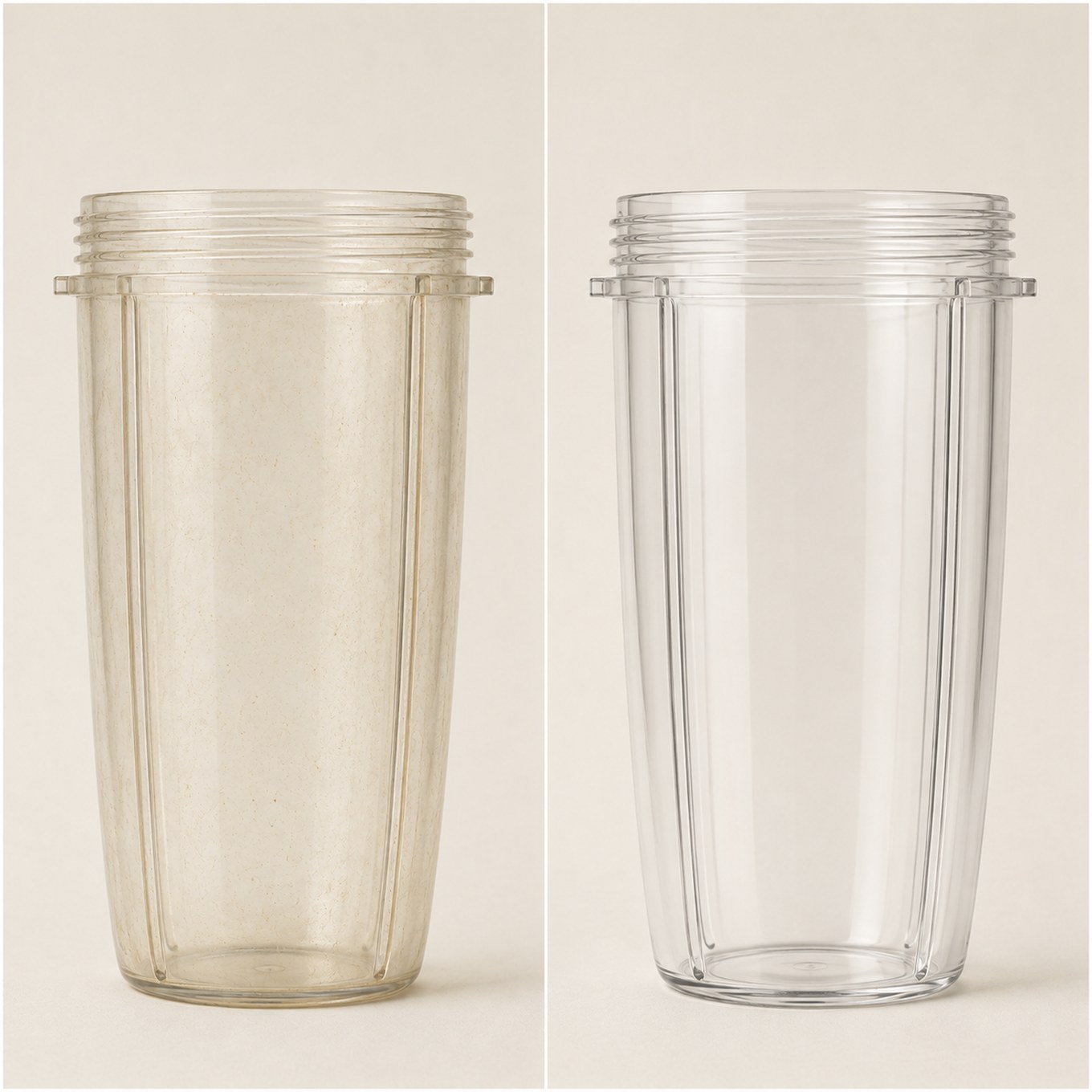
- The Reset. The ninety-second clean, the five-minute weekly deep clean, and fixes for what you are already living with: the cloudy jar, the smell, the stain, the gasket, and the honest dishwasher answer. Written for machines coming back out of cabinets, including the stain you assumed was permanent.
- The Formula. Why smoothies leave you hungry and the exact targets that fix it: 25 to 30 grams of protein, 8 to 12 of fat, 8 to 10 of fiber. Three built recipes as worked examples, and a diagnostic table that takes whatever yours keeps doing wrong from symptom to cause to fix. This page and the clean are printable cards, made for the fridge.
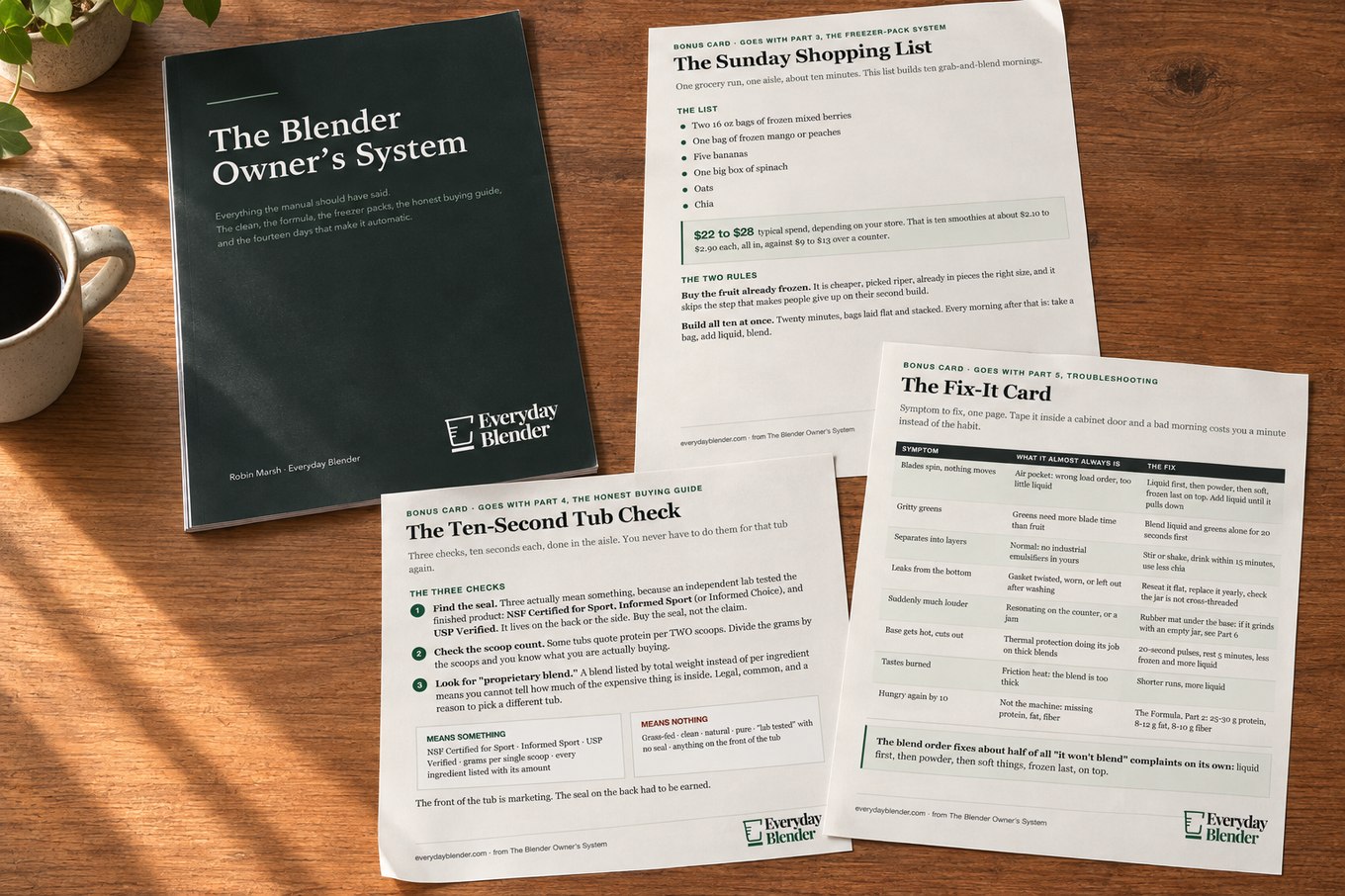
- The Freezer-Pack System. One twenty-minute session builds ten grab-and-blend mornings. The exact shopping list, one grocery aisle, $22 to $28. That is the $2.10-to-$2.90 smoothie against the $9-to-$13 one at the counter.
- The Honest Buying Guide. Protein powder after the heavy-metals testing: the three certification seals that actually mean something, how to read the back of any tub in ten seconds, whey against plant settled in a page, and the straight answer on $79 greens powders.
- Troubleshooting. Won't blend, gritty, separates, leaks, loud, hot. Symptom to fix, one table. These six are nearly every unhappy note I ever read that was actually about the machine.
- Make It Last. What the noises mean, the three parts that actually wear, and the honest repair-or-replace call, with the price math that decides it.
- The Fourteen-Day Run-In. One five-minute action a day, from "I own one" to "I don't think about it." Day one is the ninety-second clean. No day asks for more than five minutes.
The part that pays for the book
The freezer-pack chapter has a number in it that I did not expect when I worked it out.
Built from the shopping list in Part 3, each smoothie lands at roughly $2.10 to $2.90, all in, protein powder included. The version bought over a counter runs $9 to $13.
One smoothie each weekday, made instead of bought, for twenty minutes of assembly a week. Most machines have paid for themselves inside about six weeks on that math.
I am not going to pretend that is why you will keep doing it. You will keep doing it because the mornings get easier. But it is a genuinely large number for twenty minutes of work, and it is worth seeing once.
The Blender Owner's System
- 49 pages, seven parts, PDF, yours forever
- Formatted for your phone and for print
- The clean and the formula built as printable cards for the fridge
- Updates included, no subscription, no upsell to a course
- BonusThe Sunday Shopping List Card: the ten-pack grocery run on one page, $22 to $28, one aisle
- BonusThe Ten-Second Tub Check: the protein label card, the three seals that matter and the two red flags
- BonusThe Fix-It Card: won't blend, gritty, separates, leaks, loud, hot, one page on the inside of a cabinet door
About the price of three counter smoothies.
Get The Blender Owner's SystemInstant download30-day guarantee
Thirty days. Read it, use it. If it doesn't earn its counter space, reply to your receipt and I'll refund it. No form, no questions.
Questions people ask
What blender do I need for this?
Any. A tall single-serve cup or a full-size jar machine, it all applies. Where the two genuinely differ, the book says which one it is talking about.
I've had mine for years and barely used it. Is this still for me?
Especially. Part 1 was written for machines coming back out of cabinets, including the ones with a stain in the bottom you assumed was permanent.
Is this just recipes?
No, and if recipes were the answer the internet would have solved this already. There are three built recipes inside the formula chapter as worked examples. The book is the system around them.
Do you sell blenders?
No. When I recommend a product I say so and I disclose it, and this book's job is the machine you already own.
Is it printed?
It's a PDF, formatted for reading on a phone and for printing. The clean and the formula are built as cards, because those are the two pages people actually stick up.
When does it arrive?
The download email lands within about fifteen minutes of buying, from [email protected]. Add that address to your contacts so it doesn't go to spam.
What if it isn't worth it to me?
Reply to your receipt inside thirty days and you get your money back. You are the judge of worth it, and I would rather refund you than have you feel sold to.
Who is writing this, and what I get out of it.
Robin Marsh is a pen name. The career is real, the notes are real, and the person writing to you is a real person who would simply rather not do this under their own name.
This page is an advertisement for a book I wrote and sell, and I earn money when you buy it. Where the book recommends a product, I say whether there is a commission attached. That is the whole arrangement.
49 pagesinstant download30 days to change your mind
PS. If you only ever use one page of it, make it the clean. Ninety seconds at the counter, while you are still holding the cup. That single habit is the difference between a machine that stays out and a machine that goes in the cabinet, and it is the reason most of those thousands of notes got written in the first place.